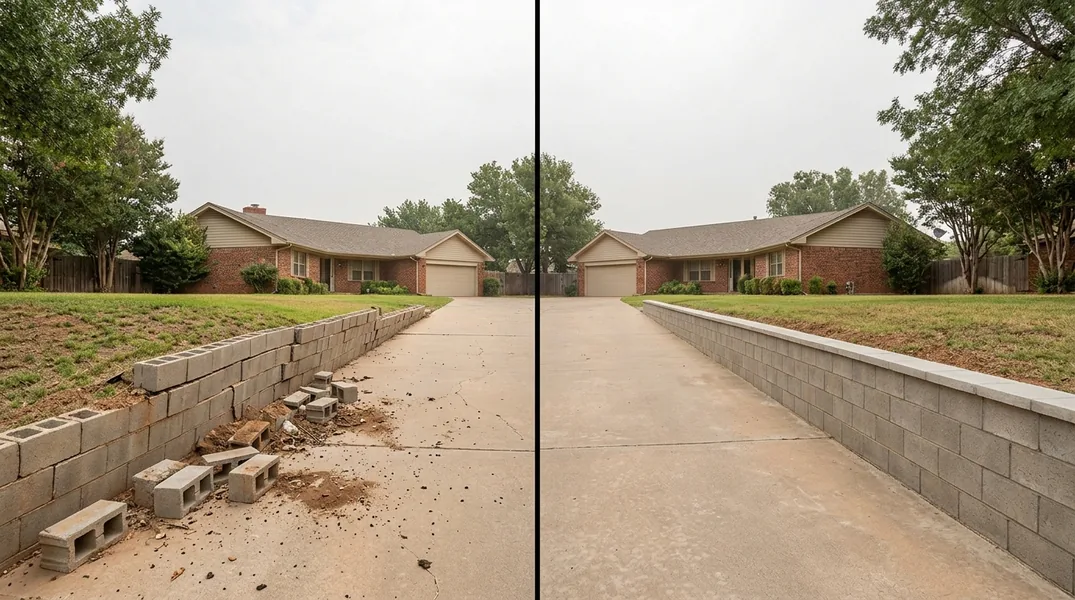
Why Lubbock's Caliche and Clay Are So Tough on Retaining Walls
If you own property in Lubbock, you already know that the ground here is not like the ground in most of the country. Underneath the topsoil, much of the area sits on caliche, a naturally cemented layer of calcium carbonate that behaves almost like soft rock. Caliche is incredibly hard when dry, which makes digging and grading a challenge from the very first day of a project. It also drains poorly, so water tends to sit on top of it rather than soak down through it.
Above and around that caliche, you often find expansive clay soils. These clays swell significantly when they absorb water and shrink just as dramatically when they dry out. Lubbock swings between wet seasons and long dry stretches, so the soil under a wall can expand and contract repeatedly over the years. That constant movement pushes against the back of a retaining wall and pulls away from its base, creating stresses that walls in more stable soils never experience. When a wall was designed for ordinary dirt but installed in caliche and clay, failure is often just a matter of time.
The Most Common Reasons Retaining Walls Fail Here
The single biggest cause of a failing retaining wall in this region is poor drainage. When water cannot escape through the backfill, it builds up hydrostatic pressure behind the wall. That pressure can be many times heavier than the soil itself, and it pushes the wall outward until it starts to lean or bow. Many failed walls were built without adequate gravel backfill, drain pipe, or weep holes, so water had nowhere to go. On caliche, where water already struggles to drain, this problem gets worse fast.
Another frequent culprit is inadequate base preparation. A retaining wall depends on a compacted, properly sized footing that reaches below the frost line and sits on stable material. Shortcuts here, like shallow footings or building directly on clay without gravel, let the wall settle unevenly. Expansive clay can also heave upward in one spot while dropping in another, which cracks mortar joints and shifts blocks out of alignment. Finally, some walls simply were not engineered for the load behind them. A wall holding back a tall slope or a driveway needs proper geogrid reinforcement and correct block sizing. When those are missing, the wall starts to move under pressure it was never built to handle.
Warning Signs: How to Spot a Leaning or Bowing Retaining Wall
Catching problems early saves money and prevents dangerous collapses. One of the first things to watch for is a leaning retaining wall. Stand back and look down the length of the wall from one end. If the top of the wall no longer forms a straight line, or if it tilts noticeably toward the street or yard, the wall is already under stress. A bowing retaining wall is similar but shows as a curve in the middle of a straight run. Both mean the pressure behind the wall has overcome its strength, and both tend to get worse over time rather than stabilize on their own.
Other warning signs include cracks that run through blocks or mortar joints, blocks that have shifted out of line, and soil settling in a visible dip along the top of the wall. Look for water pooling at the base after a rain, or dirt washing out through the face of the wall, which points to drainage failure. Gates and fences attached to the wall that suddenly stick or swing differently can also signal movement. If you notice any of these, a bowing retaining wall fix or repair is far less expensive than waiting for a section to collapse. A professional inspection can tell you whether the wall can be stabilized or needs to be rebuilt.
Retaining Wall Repair Near Me: When to Call a Pro
Some homeowners try to patch a leaning wall by adding more blocks or pushing soil back into place, but those fixes rarely last because they do not address the pressure and water behind the wall. A proper Retaining Wall Repair starts with diagnosing why the wall moved in the first place. That usually means correcting drainage with new gravel backfill and drain tile, resetting or reinforcing the base, and in some cases adding geogrid to tie the wall back into the hillside. For walls that are too far gone, a full Retaining Wall Replacement is often the safer and more cost-effective path.
If you are searching for retaining wall repair near me and want an honest assessment, call Lubbock Retaining Wall at (806) 298-6516. We serve homeowners across the region, including Ransom Canyon, Buffalo Springs, and Wolfforth. We can identify whether your wall is repairable and explain your options in plain language. Request a free estimate and get a clear plan before the damage gets worse.
Building It Right the First Time: Installation and Materials
The best way to avoid a failing retaining wall is to build it correctly from the start. Proper Retaining Wall Installation in this area means excavating below the caliche and clay to a stable base, compacting a gravel footing, and installing drainage that actually works with the local soil. It also means selecting materials suited to the load. Concrete Retaining Walls are a strong choice for taller walls and heavy loads because they resist the pressure and moisture that break down weaker systems. Segmental block walls can work well too when they are engineered with the right reinforcement and backfill.
Before any work begins, ask how the contractor will handle water. A good plan includes gravel backfill, a perforated drain pipe at the base, and a way for water to exit. It also includes compaction in lifts and geogrid where the slope or load requires it. Skipping any of these steps is exactly how walls end up leaning a few years later. If you are comparing bids, ask what is included behind the wall, not just what you will see on the surface. That hidden work is what determines whether your wall lasts decades or starts to fail.
What Retaining Wall Repair Costs in Lubbock and How to Budget
Homeowners often ask what a repair or replacement will run. There is no single number because pricing depends on wall height, length, material, access, and how much of the base and drainage system needs to be rebuilt. A small stabilization job costs far less than replacing an entire wall, which is why early detection matters so much. Walls that are still standing but leaning can often be saved with drainage corrections and reinforcement, while walls that have shifted badly or cracked through may need full replacement.
The best way to budget is to get a written assessment that separates repair from replacement and explains the tradeoffs. Ask whether the price includes excavation, new backfill, drainage, and disposal of old material, since those items drive much of the total. It also helps to plan for drainage improvements even on a repair, because fixing the wall without fixing the water problem usually leads to a repeat failure. Call (806) 298-6516 to discuss your wall and get a straightforward estimate for your property in Lubbock.
Looking for a professional retaining wall contractor in Lubbock? Lubbock Retaining Wall responds fast for all your retaining wall needs.
Get a Free QuoteOur services: Retaining Wall Installation · Retaining Wall Repair · Retaining Wall Replacement