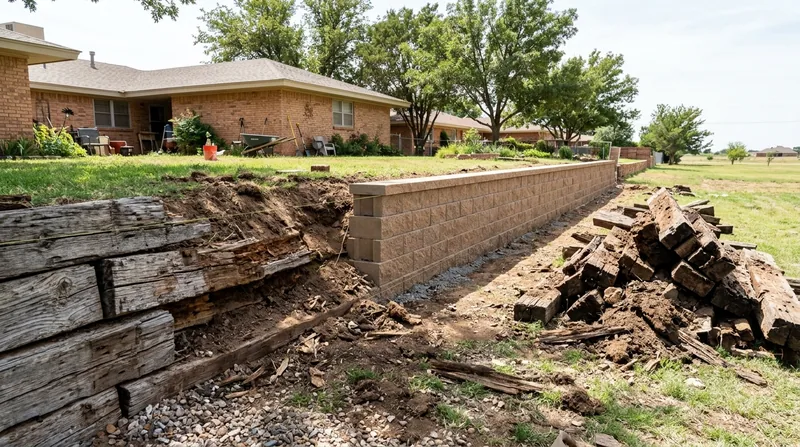




If you own an older home in Tech Terrace, Overton, or Heart of Lubbock, there is a good chance your backyard still has a railroad tie wall from the 1980s or 1990s holding up a raised bed or a sunken patio. Those creosote-soaked ties were cheap and fast to stack, but four decades of caliche hardpan trapping water, expansive clay pushing from behind, and hard freeze-thaw cycles have left many of them rotting, leaning, and bleeding creosote into the soil. Railroad Tie Wall Replacement in Lubbock means pulling those ties out, hauling them away legally, and rebuilding the wall in block, CMU, or natural stone with proper gravel backfill and drainage so it actually holds. We handle the demolition, the disposal, and the rebuild, and we build to NCMA segmental retaining wall standards. If your wall is still standing but cracked or bulging, start with retaining wall repair before you commit to a full tear-out.
Why Railroad Tie Walls Fail Faster on the Llano Estacado
Lubbock sits at about 3,200 feet on one of the flattest stretches of ground in America, and that flatness is exactly why old tie walls fail here. Rainwater does not run off, it pools on the caliche hardpan, soaks into the tie wall's soil, and then expands the clay pockets behind it. Add relentless wind, hail, and hard winter freezes, and a tie wall that would last 30 years in a milder climate starts bowing in 15.
- Creosote ties rot from the inside out where they touch wet clay, and the rot is often invisible until the wall leans.
- Expansive clay pockets swell after summer playa flooding and push the wall face out of line.
- Freeze-thaw cycles in January and February crack and split ties that looked sound in the fall.
- Ties stacked without gravel backfill trap water against the house foundation and the patio slab.
- Creosote leaching kills grass and stains concrete, and old ties are classified as treated wood waste that cannot go in a regular curbside bin.
Most of the tie walls we replace in Lubbock and Wolfforth are already past the point where patching makes sense, and the rebuild is the cheaper long-term move.
Key info: A 1990s tie wall behind a ranch house near Maxey Park was leaning 6 inches after the 2021 freeze. The ties were hollow with rot at the base and the clay behind them was saturated. We pulled 42 ties, hauled them to a permitted disposal site, and rebuilt in 6-inch CMU with a gravel drainage chimney.
For permit thresholds and engineered drawing requirements, check with the City of Lubbock Development Services before any wall above roughly 4 feet or any wall that supports a driveway or structure: Lubbock Development Services. Thresholds vary by jurisdiction and must be verified for your specific lot.
How We Tear Out and Rebuild a Tie Wall in Lubbock
Replacing a railroad tie wall is not a stack-and-go job. The ties have to come out without collapsing the slope behind them, the old gravel and clay have to be sorted, and the new wall has to be built with drainage that works on flat ground. Here is the sequence we run on a typical Lubbock backyard.
- We walk the wall with you and mark the utility lines before anything is cut or pulled.
- We shore and excavate in short sections so the slope behind the wall does not cave into the work area.
- We pull the ties, bag the creosote debris, and haul it to a permitted disposal facility, never a curbside pile.
- We excavate to the footing depth your wall height requires and compact a granular base on the caliche.
- We install a perforated drain pipe and a washed gravel chimney behind the new wall, then filter fabric to keep fines out.
- We build the new wall in block, CMU, or natural stone, compacting backfill in lifts as we go.
- We cap the wall, clean the site, and walk the drainage outlets with you so you know where water exits.
If the tie wall is part of a larger slope problem, we fold in retaining wall drainage so the new wall is not fighting the same water that killed the old one.
Key info: On a canyon-rim lot near Ransom Canyon, the old tie wall was holding a sandstone and caliche slope above a pool deck. We rebuilt it in boulder and natural stone tied into the existing rock so the wall reads as part of the canyon, not a stack of ties bolted onto it.
Rebuild Options We Use to Replace Railroad Ties
Once the ties are out, the question is what goes back in. On Lubbock's flat lots and canyon edges, the right answer depends on wall height, how much water drains to it, and whether the wall is holding a bed, a patio, or a slope. These are the four approaches we quote most often.
| Approach | Description | Best for |
|---|---|---|
| Block and segmental rebuild | Interlocking SRW block on a compacted gravel base with drain pipe and gravel backfill. | Raised beds and patio walls up to 4 feet on flat Lubbock lots. |
| CMU block rebuild | Concrete block laid in reinforced courses with a concrete footing and drainage chimney. | Taller walls and walls that carry a surcharge such as a driveway or structure. |
| Boulder and natural stone | Sandstone or caliche boulders set into the slope with gravel behind and no visible concrete face. | Canyon-rim lots in Ransom Canyon and Buffalo Springs where the wall should match the rock. |
| Poured concrete | Cast-in-place reinforced wall with formed face and integrated weep drainage. | Long straight walls along alley and driveway grade breaks where block would shift. |
| Timber rebuild | Modern pressure-treated landscape timbers on a gravel base with drain pipe, replacing creosote ties. | Low garden walls where the budget is tight and the wall is under 3 feet. |
We will tell you which of these fits your lot and your budget before you sign anything, and we do not upsell a boulder wall where a block wall does the job.
Railroad Tie Wall Replacement Cost in Lubbock: What to Expect
Most railroad tie replacements in Lubbock start at From $35/sq ft of wall face, and that figure covers tear-out, creosote haul-away, new gravel backfill and drainage, and the rebuild in block. The number moves up or down with wall height, how much of the old wall is buried, and whether the new wall has to hold a surcharge or a slope. A 2-foot garden wall in Shallowater and a 5-foot canyon-rim wall in Ransom Canyon are not the same job.
- Wall height and length drive the square footage, which is the biggest single factor in the quote.
- Access matters: a tie wall behind an alley garage in Heart of Lubbock means hand-carrying debris farther than a wall at the front curb.
- Creosote disposal is a real line item because the ties cannot go in a regular dumpster.
- Drainage adds cost when the old wall had none and the new one needs a drain pipe and gravel chimney.
- Material choice moves the price: block is the value option, boulder and stone run higher.
Get two or three written estimates and compare what is included, especially disposal and drainage, because a cheap quote that skips the gravel backfill will cost you again in five years. See our full pricing overview for the line-by-line breakdown.
Railroad Tie Wall Replacement Near Me: How to Vet a Contractor Near Lubbock
When you search for railroad tie wall replacement near me in Lubbock, you will get a mix of general handymen, landscapers, and wall specialists. A tie wall replacement involves demolition, disposal of treated wood, footing compaction, and drainage design, so ask questions that separate a wall builder from a guy with a trailer.
- Ask for proof of insurance and a certificate you can verify before work starts.
- Get two or three written estimates that list disposal, drainage, and material separately.
- Ask for references from Lubbock jobs and go look at the finished walls.
- Confirm who pulls the permit if your wall is above the local threshold or supports a surcharge.
- Ask how they will handle creosote ties and where the debris goes.
We are fully insured and carry NCMA Segmental Retaining Wall Installer Certification, and we will send our certificate on request. Reach out through our contact page to set up a free estimate, and we will tell you straight whether your tie wall needs a full replacement or a repair.
Railroad Tie Wall Replacement in Lubbock: Pricing Guide
| Service | Price | Details |
|---|---|---|
| Railroad tie wall replacement, block rebuild | Starting at $35/sq ft | Includes tie tear-out, creosote haul-away, gravel backfill, drainage, and block rebuild; height and access move the price. |
| Railroad tie wall replacement, boulder or natural stone | Starting at $55/sq ft | Includes demolition, disposal, and stone rebuild; canyon-rim access and stone sourcing move the price. |
| CMU block rebuild with footing | Starting at $60/sq ft | Includes reinforced footing, drainage chimney, and CMU courses; wall height and surcharge load drive the number. |
| Complex or large-scale job | On estimate | Tiered walls, surcharge loads, and canyon-rim slopes need an on-site look before we quote a number. |
| Travel | Included | in Lubbock and surrounding areas, no separate call-out or mileage fee. |
| Estimate | Free | Response within 24h at (806) 298-6516, no obligation to book. |
Indicative pricing, the exact cost depends on square footage, finish, and site access. Free personalized estimate within 24h at (806) 298-6516.


