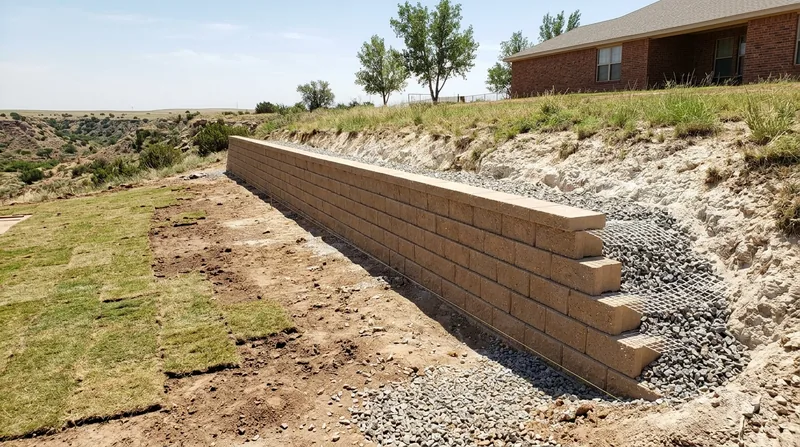




Retaining Wall Installation in Lubbock: Built for Caliche, Clay, and Playa Floods
Lubbock sits on the flat high plains of the Llano Estacado at about 3,200 feet, one of the flattest cities in America, broken only by the cut of Yellow House Canyon and the shallow playa lakes that fill after summer downpours. That flat ground hides two things that wreck retaining walls: caliche hardpan that traps water against the back of a wall, and pockets of expansive clay that swell and shrink with every wet and dry cycle. Retaining Wall Installation in Lubbock is not a weekend block-stacking job here. It is an engineered base, gravel backfill, and drainage job that has to survive hail season, hard freezes, relentless wind, and sudden playa flooding. We build new walls for canyon-rim lots in Ransom Canyon, playa-edge yards near Maxey Park, sunken patios and pool decks on flat lots, and raised beds across Tech Terrace and Rush. Every wall starts on compacted base through caliche and clay, with drainage that moves water out before it pushes the wall out of line. If an existing wall is already leaning, start with retaining wall repair before the footing gives up.
Why New Retaining Walls Fail Fast on Lubbock's Flat Plains
Most wall failures we see in Lubbock were never a material problem. They were a water problem. On a lot with almost no natural slope, stormwater from a playa or a neighbor's alley garage has nowhere to go, so it sits against the wall face and soaks into the backfill. Caliche below the footing holds that water like a bathtub, clay swells, and the wall rotates. Add hard winter freezes and ice storms and the cracks open wider every season.
- Caliche hardpan traps water against the wall and softens the base if the footing is shallow.
- Expansive clay pockets push walls out of line as they swell and shrink through the year.
- Playa flooding after summer downpours overloads walls with no gravel backfill or drain.
- Hail and wind-driven dust beat on block faces and open joints over time.
- Hard freezes and ice storms crack mortar and lift poorly drained footings.
We design every new wall around those five failure modes, not around a pretty block pattern.
Key info: A split-face block wall in Tech Terrace that looked fine in June heaved 2 inches by February because the builder skipped gravel backfill and set the footing straight on caliche. The homeowner paid twice: once for the wall, once to rebuild it.
Before you build, check what your local building department requires. Many jurisdictions require a permit for walls above roughly 4 feet measured from the footing, or whenever the wall supports a surcharge like a driveway or structure. Engineered drawings are often required for tall or tiered walls. The City of Lubbock's development and permitting resources are the place to verify thresholds: City of Lubbock official site.
How We Build a Retaining Wall That Holds Through a Lubbock Freeze
We do not guess at a wall. We read the lot first: where the water runs, where the caliche shelf sits, how close the wall is to the house, the alley, or the pool deck. Then we build the wall in a sequence that puts drainage in before the block ever goes down. That order is the difference between a wall that lasts 30 years and one that leans by the third spring.
- We walk the lot and mark the wall line, checking grade and where playa or roof water actually drains.
- We excavate through caliche and clay to a stable bearing depth, not just to the first hard layer.
- We compact a granular base in lifts and verify it before setting the first course.
- We install gravel backfill and a drain system so water exits the wall instead of sitting behind it.
- We set and level each course, compacting backfill as we go, and cap the wall clean.
- We test drainage before we call the job done and leave the site graded to move water away.
That sequence is why we hold NCMA Segmental Retaining Wall Installer Certification and build to that standard on every block and segmental job.
Local example: On a canyon-rim lot in Ransom Canyon, the wall had to hold a raised patio above a sandstone drop while shedding runoff from the caliche shelf above it. We set a compacted base, ran gravel backfill and a drain to daylight, and the wall has taken two hail seasons and a hard freeze without moving. See how we handle retaining wall drainage on lots like yours.
Wall Types We Install Across Lubbock and the Surrounding Towns
The right wall depends on the load, the look, and the water. A pool deck in Lakeridge and a canyon-rim wall in Buffalo Springs do not want the same material. Here is how we match the approach to the job.
| Approach | Description | Best for |
|---|---|---|
| Block and segmental (SRW) | Interlocking block on compacted base with gravel backfill and drain. | Raised beds, sunken patios, pool decks on flat lots. |
| Poured concrete | Reinforced wall formed and poured on a stable footing. | Grade breaks at alley and driveway, heavy surcharge loads. |
| Boulder and natural stone | Caliche-rock and sandstone set with drainage behind the face. | Canyon-rim lots in Ransom Canyon and Buffalo Springs. |
| Timber | Treated timber on gravel base with drainage for low walls. | Low garden walls and budget-conscious backyard beds. |
| Slope stabilization | Terracing and erosion control on sloped or playa-edge ground. | Canyon cuts and yards that wash out after downpours. |
If your existing wall is timber or railroad tie and already rotting or leaning, we replace it rather than patch it. See railroad tie wall replacement for that path.
Retaining Wall Installation Cost in Lubbock: What to Expect
Our new wall work starts from $30 per square foot of wall face, and that figure is a starting point, not a flat quote. The number that matters is the one after we see your lot. A short garden wall on flat ground in Wolfforth prices very differently from a tall tiered wall holding a pool deck in Lakeridge.
- Wall height and length drive the block count and the excavation volume.
- Caliche depth and how much rock we have to cut changes the labor.
- Access for equipment matters on tight alley lots in Heart of Lubbock.
- Drainage and backfill scope, including where water has to exit, adds cost but prevents failure.
- Engineered drawings and permits for tall or surcharge walls add a step.
Get two or three estimates and compare the drainage scope, not just the price. A cheap wall with no drain is the most expensive wall you can buy. Our full breakdown lives on the pricing page.
Retaining Wall Installation Near Me: How to Vet a Contractor Near Lubbock
You are hiring a contractor to put a structural wall on your property, so vet them like it. A wall that fails takes the patio, the driveway, or the pool deck with it. These are the checks that matter before anyone breaks ground on your lot.
- Ask for proof of insurance and confirm the certificate is current before work starts.
- Get two or three written estimates and compare the drainage and base scope line by line.
- Ask for local references on walls like yours, not just photos of pretty block.
- Confirm who pulls the permit and whether engineered drawings are required for your wall height.
- Check HOA rules for wall height, material, and setback before you sign anything.
We are fully insured and hold NCMA Segmental Retaining Wall Installer Certification, and we will walk you through the permit question for your specific lot. Reach us through the contact page to set up a free estimate.
Retaining Wall Installation in Lubbock: Pricing Guide
| Service | Price | Details |
|---|---|---|
| Low garden wall (timber or block) | Starting at $30/sq ft | Under 3 ft on flat ground, includes compacted base and gravel backfill. |
| Block and segmental wall (SRW) | Starting at $38/sq ft | Includes drain, gravel backfill, and cap; height and caliche depth move the price. |
| Poured concrete wall | Starting at $45/sq ft | Reinforced wall on stable footing; surcharge loads and tight alley access add cost. |
| Boulder and natural stone wall | Starting at $50/sq ft | Caliche-rock or sandstone face; canyon-rim access in Ransom Canyon affects labor. |
| Complex or large-scale job | On estimate | Tiered, engineered, or surcharge walls need an on-site look before any number. |
| Estimate | Free | Response within 24h at (806) 298-6516, no obligation to book. |
Indicative pricing, the exact cost depends on square footage, finish, and site access. Free personalized estimate within 24h at (806) 298-6516.


