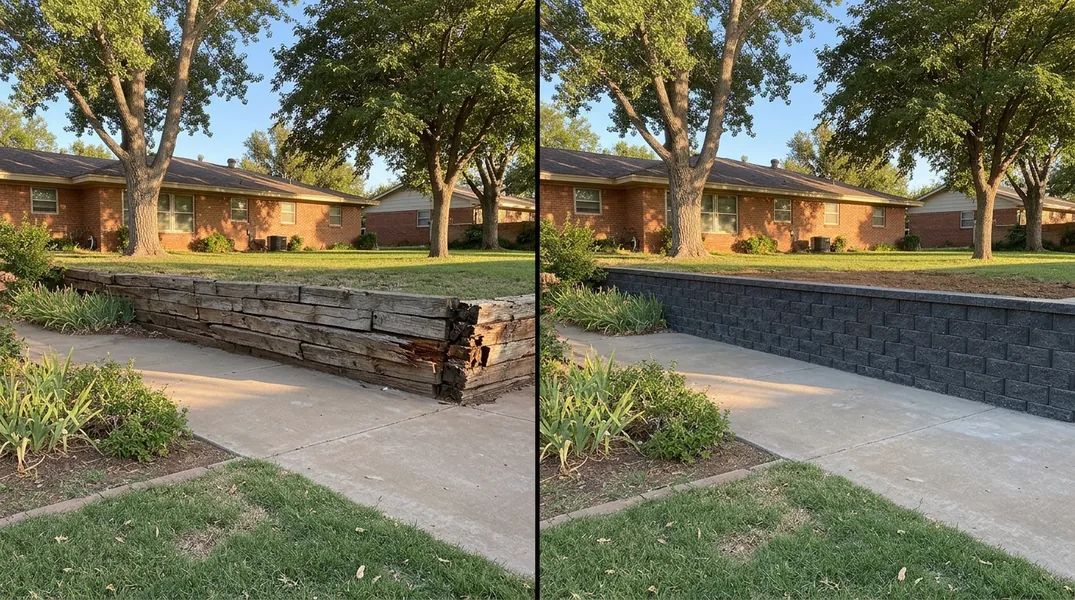
Why Lubbock Downpours Are So Hard on Retaining Walls
Lubbock sits on the South Plains, where rainfall often arrives in short, intense bursts rather than gentle all-day showers. A single storm can drop an inch or more in under an hour, and the caliche-heavy soil common around the region does not absorb water quickly. That combination means a tremendous volume of water has to go somewhere fast, and all too often it ends up behind a retaining wall.
When water cannot drain away, it saturates the backfill soil and creates what engineers call hydrostatic pressure. That pressure pushes against the wall from behind, and it can be many times stronger than the static weight of the soil alone. A wall that looked perfectly solid during the dry season can begin to lean, crack, or bulge after just a few major storms. Homeowners in Lubbock who have watched a wall fail after a downpour often describe it as sudden, but the damage usually builds up over many rainy seasons.
The Silent Killer: Hydrostatic Pressure and Retaining Wall Drainage
Hydrostatic pressure is the force water exerts when it is trapped and cannot flow freely. Behind a retaining wall, water collects in the backfill and in any voids within the wall itself. As the water level rises, the pressure against the back of the wall increases. If the wall was built without adequate drainage, that pressure has nowhere to go except into the structure, which is why hydrostatic pressure retaining wall failures are one of the most common causes of collapse after heavy rain.
Good retaining wall drainage is not an optional add-on. It is a core part of the design. A properly built wall includes a drainage layer of gravel behind the wall face, a way for water to exit at the base, and often a perforated pipe to collect and redirect water. When any of those elements is missing, clogged, or installed incorrectly, the wall becomes a dam holding back saturated soil. Over time, even a well-built wall can be pushed out of alignment, and the repair bill grows with every storm that passes.
How a Retaining Wall French Drain Protects Your Property
A retaining wall french drain is a simple but highly effective system: a perforated pipe set in a gravel trench behind or at the base of the wall, wrapped in filter fabric to keep soil from clogging it, and sloped so water flows away to a safe discharge point. The fabric lets water in while keeping fine soil particles out, which is critical in Lubbock where clay and caliche can quickly seal off a pipe. When the drain works as intended, water never gets the chance to build up behind the wall.
Many older walls in the area were built without any drainage at all, or with a drain that has long since filled with sediment. If you are unsure whether your wall has a functioning french drain, a professional inspection can tell you quickly. For walls that are still structurally sound, targeted Retaining Wall Repair can restore drainage and relieve pressure before major damage occurs. For walls that are already leaning or cracked, a full assessment is the safest first step.
Warning Signs Your Wall Is Losing the Drainage Battle
Homeowners should watch for a few clear warning signs after heavy rain. Water pooling at the base of the wall, soil washing out from behind the structure, or a visible bulge in the wall face are all red flags. Small cracks that widen over time, especially horizontal cracks, suggest the wall is being pushed outward by pressure it was never designed to handle. Efflorescence, the white chalky staining on concrete or masonry, can also indicate that water is moving through the wall and depositing minerals as it dries.
Ignoring these signs rarely saves money. A wall that is beginning to fail can often be stabilized with drainage improvements and reinforcement, but once it collapses, the job becomes a full Retaining Wall Replacement with excavation, disposal, and new materials. Catching the problem early is the single best way to protect both your landscape and your budget.
Retaining Wall Installation Near Me: Building It Right the First Time
If you are planning a new wall, the most important decision is choosing a builder who understands local soil and rainfall. A wall that works in a dry climate may fail quickly in Lubbock if it lacks proper drainage. During Retaining Wall Installation, the contractor should excavate to the correct depth, install a compacted gravel base, place a drainage layer and french drain behind the wall, and backfill with free-draining material. Skipping any of these steps is how walls end up failing after the first big storm.
Material choice matters too. Concrete Retaining Walls are popular in the area because they handle pressure well and last for decades when properly drained. Block and timber walls can also work, but they are less forgiving of poor drainage. If you are searching for retaining wall installation near me, ask specifically how the contractor handles water behind the wall. A good answer will mention gravel, filter fabric, a perforated pipe, and a clear discharge plan.
Retaining Wall Drainage Cost in Lubbock: What to Budget
The cost of fixing drainage depends on the size of the wall and how much damage has already occurred. Adding a french drain to an existing wall is typically far less expensive than replacing a failed wall, and it is one of the highest-value improvements a homeowner can make. Factors that affect pricing include wall height, length, access to the site, soil conditions, and whether the existing wall needs structural reinforcement in addition to drainage work.
Because every property is different, the only reliable way to know what your project will cost is an on-site assessment. A contractor can measure the wall, check the soil and slope, and recommend the right drainage solution for your situation. If you would like a clear picture of what your wall needs, reach out for a free estimate or call (806) 298-6516. Protecting a wall with proper drainage now is almost always cheaper than repairing or replacing it after the next Lubbock downpour.
Looking for a professional retaining wall contractor in Lubbock? Lubbock Retaining Wall responds fast for all your retaining wall needs.
Get a Free QuoteOur services: Retaining Wall Installation · Retaining Wall Repair · Retaining Wall Replacement